Photo Credits: Vatican News
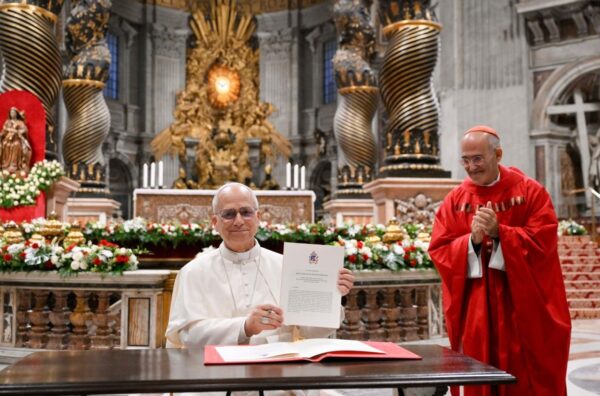
In Pope Leo XIV’s view, service-learning is one of the “stars shining brightly” in the constellation of educational institutions and initiatives that must “draw new maps of hope.” This is the title of the Apostolic Letter that Leo XIV wrote to celebrate the 60th Anniversary of the Second Vatican Council Declaration Gravissimum educationis, in which he recalls that education is “an act of hope,” “a labour of love that is handed down from generation to generation,” and that it is not limited to the transmission of knowledge, but must “[form] citizens capable of serving and believers capable of witnessing” (5.1).
The document was released on 28th October by the Vatican, as part of the Jubilee of the World of Education that took place between October 27 and November 2 of this year, 2025, in Rome. in Rome, in which the founder and Director of the Latin American Centre for Service-Learning (CLAYSS), Nieves Tapia, participated, alongside the Coordinator of Uniservitate, María Rosa Tapia, and its Vice-Coordinator, Andrés Peregalli.
The Vatican’s Dicastery for Culture and Education invited the CLAYSS-Uniservitate delegation to be part of the Global Compact on Education Committee, an initiative of Pope Francis that Pope Leo XIV has strongly re-launched in the new document.
Regarding the letter, Nieves Tapia said: “For those who work in the service-learning, this document is a source of great encouragement. On the one hand, in the face of new challenges posed by technology, the Pope proposes ‘enhancing active teaching; promoting service-learning and responsible citizenship; and avoiding any technophobia’ (9.2). On the other hand, it explicitly includes service-learning initiatives as part of the ‘constellation’ of the Catholic educational world, ‘a living and pluralistic network’ in which ‘Each star has its own brightness, but together they chart a course’ (8.1).”
The inclusion of the service-learning pedagogy in the papal magisterium is consistent with its growing appreciation it has received, beginning during the pontificate of Pope Francis, with very significant milestones such as its inclusion in the preparatory documents for the World Congress on Catholic Education held at the Vatican in 2015, where Nieves Tapia was invited to present service-learning at the closing session with Pope Francis. Service-learning is explicitly mentioned in the Vademecum of the GCE, so CLAYSS and its global network, Uniservitate, have received numerous encouraging messages from Pope Francis and the Dicastery.
Our last meeting with Pope Francis was particularly memorable: In his Address to the Participants in the V Uniservitate Global Symposium in November 2024, he stated that “education programmes should bring students into contact with the realities around them, so that, starting from experience, they learn to change the world not for their own benefit, but in a spirit of service.”
This inclusion is also consistent with the expansion of networks promoting service-learning worldwide, the introduction of this approach to education in public policy in several countries, and its inclusion in official documents from organizations like UNESCO, which call for service-learning to be considered one of the paths of education in the future.