🥇Uniservitate Award 2024 winning experience
Summary
Through courses in Architecture, the Universidad Centroamericana José Simeón Cañas (UCA), in El Salvador, and KU Leuven partner in investigation and architectural design of grassroots memory projects related to El Salvador’s civil war (1980-1982). The project is a partnership between universities and also between community members, survivors, artists and from both countries.
EXPERIENCE DEVELOPMENT
Dates:
From: 2023 (August)
Continues
Context: The projects are initiated as part of an international collaborative research project on El Salvador’s post-war memory, supported, and monitored by Asociación Sumpul, a non-profit organization of massacre survivors. Architecture and public spaces, including artistic interventions, are seen as important vectors of Historic Memory to strengthen the community-building processes and prevent future violences, especially in a challenging negationist and repressive political context.
Objectives:
Solidarity action: The aim is to encourage reflection and develop design strategies that the communities can implement or refine with the design team. A second objective is to provide a platform for survivors and communities to share their experiences since it is crucial for healing and preserving memory, as well as encouraging collaboration among all stakeholders in the project.
Learning: To foster students’ ability to collaboratively research and design in sensitive contexts; to emphasize and learn the value of thorough observation, participation, and conversations; and to explore the interplay between architecture, memory, and civil/state violence.
Direct beneficiaries of the solidarity action: From children to senior citizens, all survivors of massacres against civilians and victims of military, paramilitary and governmental repression during the civil war in El Salvador, including their relatives and communities. The population in the areas is generally impoverished and may have suffered physical and mental injuries (such as Post-traumatic stress disorder). Estimated 100 direct participants over 10,000 community members as indirect beneficiaries.
Type of service: Mixed/hybrid form
Fifty students and 4 professors participate in the project.
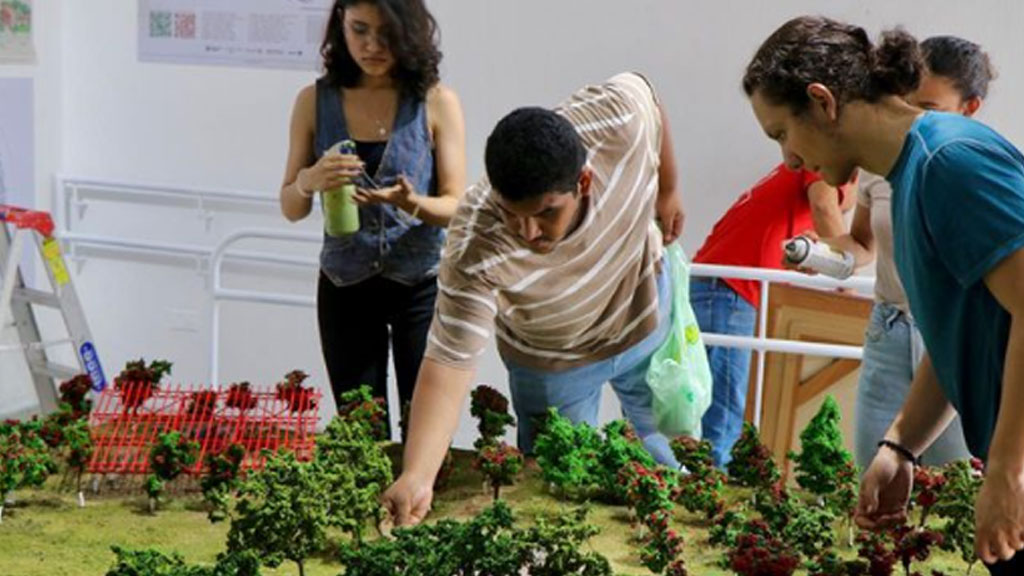
Main activities carried out by students: The program features exchanges with KU Leuven and UCA students: Students in El Salvador carry out fieldwork while KU Leuven engage in documentation and literature review, participate in frequent workshops with survivors, community members, artists, scholars, collaborators, etc. In parallel, they develop design proposals for the different historically significant sites, and reflect on similar situations and sites in their personal contexts.
Number of weekly hours that students dedicate to the project: 4 hours per week during a semester.
Mandatory nature: It’s mandatory for some students but voluntary for others
Results:
A. Students: The project helped students develop a keen awareness of the social impact of architectural design, enriching their academic and professional growth. There was evidence of improvement in both academic learning and the development of professional skills among the students. Notably, there was an increased capacity to handle multidisciplinary and sensitive contexts involving diverse stakeholders.
B. Community: The project helped massacre survivors to share their experience and the entire community to redefine it. The experiment also led to changes in understanding about ongoing projects. For instance, student work contributed to the historical significance and preservation of places key to the people’s history. This shift in understanding is crucial for the long-term design process and for developing an appropriate approach to the architectural projects of the communities.
Audiovisual material and further information:
- Web: https://www.elsalvadormemory.org/ (project’s website, not the experience)
- RRSS
Instagram: https://www.instagram.com/memoria_el_salvador/ (project’s instagram, not experience)
YouTube: https://www.youtube.com/@memoriahistoricaenElSalvador/videos (project’s youtube)
DATA SHEET
- Experience Title: Surviving Memory in Postwar El Salvador
- Region: Northern Europe
- Country: Belgium
- Institution: Catholic University of Leuven (KU Leuven)
- Department involved: School of Architecture
- SDG Theme:H. Promoting peaceful and inclusive societies (SDG 16, and GCE 2, 4 and 5).
- Place of implementation:El Salvador (Latin America)
- Responsible for the experience: Harold Fallon and Edgar Alexander